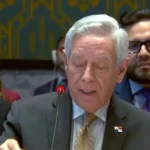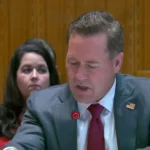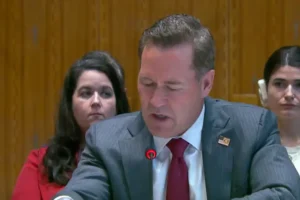


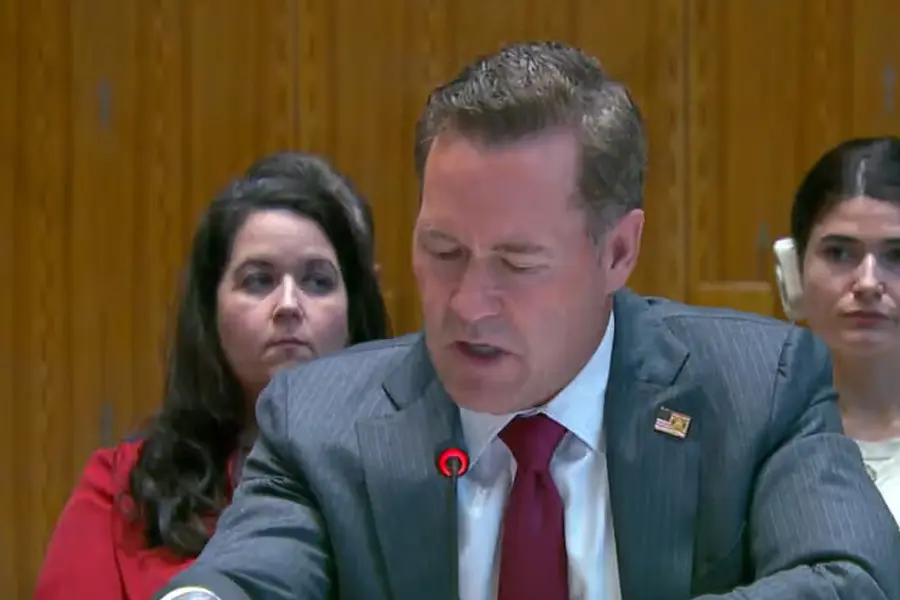
Mike Waltz, US representative to the UN Security Council, at the council’s meeting on Afghanistan, accused the Taliban of hosting terrorist groups and warned that the consequences of Afghanistan’s developments are not limited to the country’s borders.
On Wednesday, September 16 (25 Sunbula), Waltz called on the Security Council to compel the Taliban to take practical actions rather than settling for promises in engaging with the group.
He said Afghanistan’s future path and the extent of its movement toward peace and legitimacy will depend on the Taliban’s performance.
According to the US representative, the Doha process can still provide a basis for progress on the Afghanistan file, but utilizing this potential will depend on the Taliban’s serious participation and implementation of the commitments the group has accepted.
Waltz also accused the Taliban of unfairly detaining US citizens and nationals of dozens of other countries and using them to extract money or political concessions.
He added that foreign citizens in such conditions have become a bargaining tool for the Taliban with the international community and emphasized that the US will not tolerate the detention of its citizens by the Taliban.
The US representative asked Security Council members to condemn the mentioned detentions and call for the immediate release of those detained.
He also said Marco Rubio, US Secretary of State, in March placed Taliban-ruled Afghanistan on the list of countries associated with “wrongful detentions” due to what Washington considers arbitrary detention of foreign citizens.
To illustrate what he called the Taliban’s pressure method, Waltz referred to the case of a former Afghan interpreter who had left the country after the fall of Kabul.
According to him, the Taliban used the phone of the interpreter’s 10-year-old niece to threaten the family and warned that if the interpreter did not return to Afghanistan, the child would face consequences.
Referring to this incident, he said the Taliban targets innocent individuals when it needs leverage and asked the Security Council to take a “realistic” approach in evaluating the Taliban’s performance.
The US representative then addressed UN reports on the human rights situation in Afghanistan and expressed concern about continued arbitrary detentions, torture, ill-treatment, forced disappearances, and extrajudicial killings.
He also criticized the ban on girls’ education above the sixth grade and said this restriction has entered its fifth year.
According to statistics he attributed to UNESCO, approximately 2.2 million Afghan girls are deprived of education.
Waltz added that Afghanistan remains the only country in the world where women and girls are not allowed to study at the secondary and university levels.
The US representative also referred to a UNAMA report about the detention and harassment of 30 women for what the Taliban called violations of dress code regulations.
He noted that protests against these detentions were also violently suppressed.
Waltz described the ban on Afghan women working for the United Nations as contrary to international law and the UN Charter and said such restrictions have made aid operations difficult and obstructed Afghanistan’s reintegration into the international community.
Referring to the contradiction between the Taliban’s desire for presence in international institutions and the group’s domestic policy in Afghanistan, he said the Taliban seeks a place in the international community and the UN while barring women from entering UN offices in Afghanistan.
In another part of his remarks, Waltz referred to UN Security Council Resolution 2822 and stated that the exclusion of women, girls, and minorities from Afghan society is among the obstacles to the country’s peace, stability, and prosperity.
This resolution extended the mandate of the UN Assistance Mission in Afghanistan (UNAMA) until June 2027.
The US representative welcomed the reform of UNAMA’s mandate and the appointment of Roza Otunbayeva as the UN Secretary-General’s Special Representative for Afghanistan.
However, he noted that Washington expects the new UNAMA leadership to pursue the mission’s achievements in a measurable manner and for the office to act more accountably, purposefully, and focused in the future.